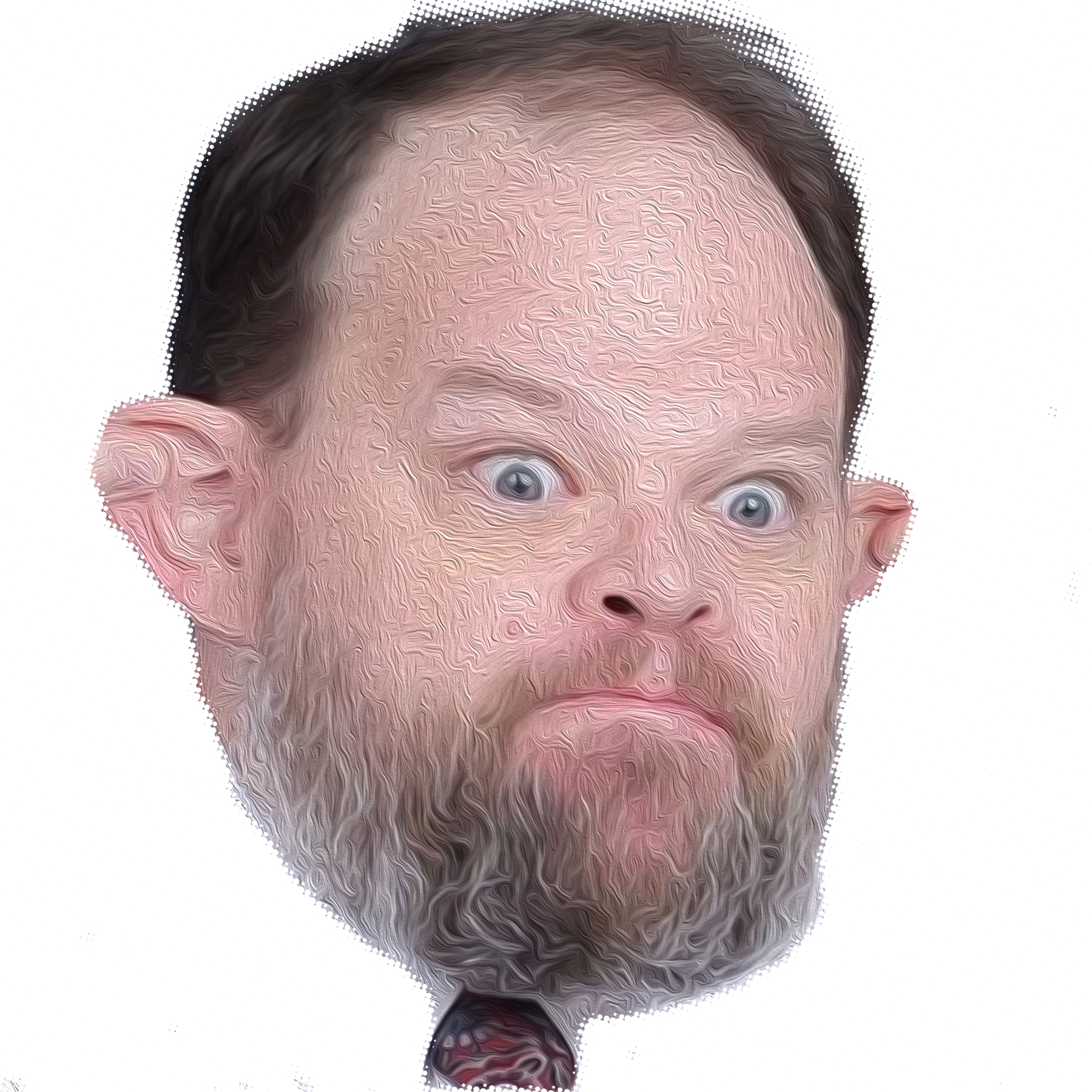
He invented a filter that just replaces your photo with that one picture of Prince Charles (pre-ascension) sneezing. In the first iteration of the filter, it replaced the user’s image with a picture of a woman in a wool bathing suit. After deliberation, though, Charles Sneeze Dot Jpg was the clear answer.
I hear the gathering throng gasping, “why Charles?”
We begin with a fact, which leads to a presumption. The most popular filters are those that either smooth the features of a user to a cartoonish sheen, or simply replace all or part of the user’s actual picture with pieces of similar, simpler pictures of people whom society agrees are attractive. Using the pathetic lump that passes for Artificial Intelligence, an application maven can create a filter, an add-on upcharge to an existing application, that will simply replace parts of an existing, perfectly acceptable photograph, with adapted parts of one which closer adheres to a perceived societal norm of regal beauty. Replacing one part of the gritty photograph with a similar part of perfection. An eye, as it were, for an eye.
In the realm of boring internet photography, whiteness is king. Slimness is queen. Featurelessness is prince. Paleness is a minor duke and duchess. Nudity is an earl.
All these pictures look the same, and the problem with every filter making the user look the same is, why would the user select any but the least expensive filter? There are only two ways to charge more than a pittance and successfully sell yet another filter that applies a hostile veneer of uniformity: sell a filter that uniquely applies a hostile veneer of uniformity; or sell a filter that applies a hostile veneer of unique uniformity.
Unique application requires coding, which requires a coder, who requires skill, which takes time, which costs money. Unskillful code results in refunds, and refunds result in diminished spoils.
The answer is unique uniformity. Make everyone look the same, but not like the same person everyone else makes everyone look like. Make everyone look like the same somebody unique. But who?
The idea that came before the first iteration was The Model. There is a woman, a model, who has appeared in several thousand photos. Often, she appears in a bathing suit. She is regarded, generally, as quite attractive. I do not mention her name because a) she owns it and I have no money to pay her, and b) she is inarguably attractive. You know who she is. Her name rhymes with “Valiant Wolf,” and she is the first name you thought of when I said “a woman, a model,” above.
Every photograph of her is owned, and the owner of every photograph of her is territorial. Anyone who has ever photographed The Model is aware, they have captured golden lightning in a jar of fireflies. They have killed the fatted goose to welcome the prodigal calf. They have, in the words of Rod Blagojevich, “got this thing and it’s [decidedly] golden.”
And so the search was on, for a unique but ubiquitous photograph of the best-beloved model, which photograph was available at a cheap-as-free price. The budget, went one version of the story, was $5, which is in its way worse than nothing.
Eventually, someone landed upon the National Archives. Within the archives are countless photographs. Many are old enough to have certainly entered the venerable and doddering public domain. For example, photographs of young women frolicking in the edges of Lake Ontario, wearing wool bathing suits. These are part of a series of photographs commissioned by a failed early parks project by Robert Moses’ sworn bette noir, FDR.
One such photograph featured an especially striking young woman. The light hit her and deprived her of all detail. Her skin looked paperwhite in one light and a fetching gray in another (remembering that this is monochrome photography). Her hair was made up in black ringlets that glowed gold in the peculiarly overexposed photograph. Her smile looked like she had just heard a joke that cast her understanding of bicycles and tires into a new light, while she simultaneously discovered she had stepped in a hole full of acorns. She was delightfully memorable and uniquely unmistakable while being absolutely impervious to description beyond blandishment. An early supermodel with resting girl-next-door face. The nameless photographer seemed to agree, as there were more than six photographs of her, and of the seven, five were in sufficiently good condition to be useable.
Perhaps most importantly, the photographer had been dead since an unfortunate cave-in in 1928, and the photographs had slid comfortably into the public domain. Perfection!
Perfection must precede only calamity, of course. A deeper dive revealed two facts which rendered the photographs forge scale in the grand workshop of culture. First, the model in the pictures was The Model’s great aunt. This rendered use of the pictures suspect. Because The Model is (and remains) a cultural touchstone, stealing her fire is hardly a coup.
As if this taint were insufficient, in 1932, she was heard to have muttered, “Beep.”
Perhaps I need not explain this, as the Armenians have a strong enough cultural presence in Modern America, but a racial slur might be forgivable if spoken aloud. But, to have hissed it under her breath? Suffice to say, if her susurration had echoed in the halls of Noravank, she would have been butchered like a Christmas ham.
In any event, she was no longer a possibility for the paragon of cheap beauty the application required. And so the search continued.
Despairing, he finally ended up at home, digging madly through his childhood ephemera to find something to sell, when he stumbled across his salvation.
In his extreme youth, he had been allowed to attend an exhibition of royalty in which Prince Charles travelled the United States, sitting in an unremarkable steel folding chair, and throngs could attend an hour to watch him be royal. As a youth, he was entirely taken by the process of celebrity, and he insisted upon taking a photograph of the future monarch. And, at the fateful moment, he sneezed.
The flash went off, the second was preserved forever, and at that moment decades later, he fell upon the picture with a ferocious intensity that was barely earned. He carried it, high over his head, directly to the office, scanned it, and went live with the filter.
In a matter of moments, sixty distinct people had downloaded it. Their decision led to two thousand more, and they trickled up to six million downloads. Six million people replacing their own photographs with the picture he took of Prince Charles. He thought of it often.
This is untrue. He thought of the money, always, only, and ever.